

The example data
This guide uses the public transport stops of Graubünden, Switzerland, to show refiroo with recognisable records and connections. The reference instance’s Graubünden workspace runs the model Public transport stops of Graubünden 1.0.0. Its data is a dated snapshot from 2 November 2026, rather than a current transport information service.
The model defines three applications, Network, Systems and Names. They demonstrate capabilities; refiroo does not require these applications or know what their record types mean.
Network
Section titled “Network”Network holds stops, cantons, districts, municipalities, operators and transport modes. The Stops table demonstrates records, lists and filters and finding records. Geography arranges canton, district, municipality and stop; Modes nests modes under other modes. Both demonstrate hierarchies. Relationships connect stops to operators and modes without making those records their parents.
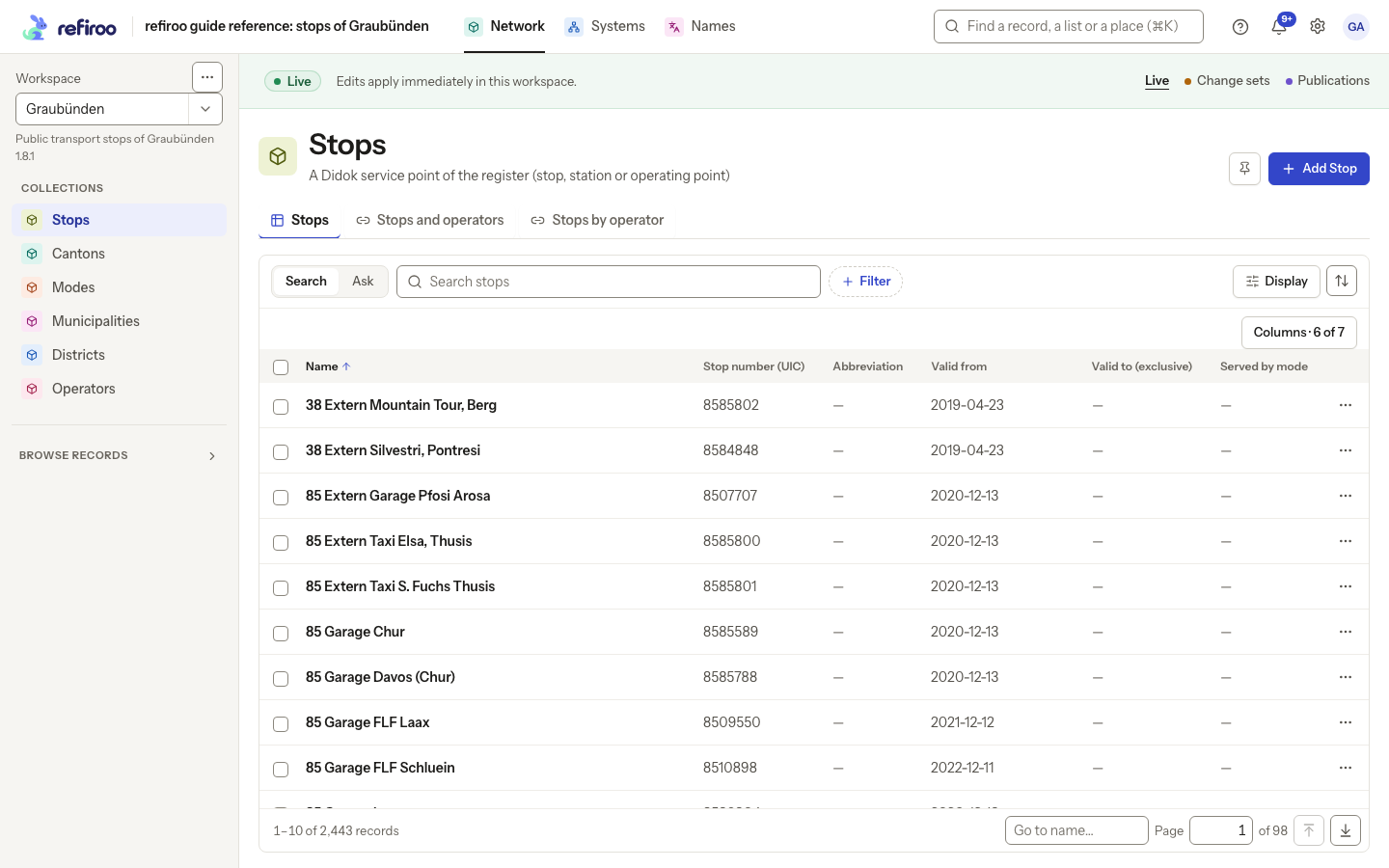
Above: Network in Graubünden shows the Stops collection. The reference set contains 2,443 stops, 100 municipalities and 71 operators. The numbers describe this snapshot, not refiroo’s limits.
Systems
Section titled “Systems”Systems holds records for other systems and their codes. Its System codes hierarchy organises codes beneath systems and groups. Mapping grids connect those codes to stops or municipalities. A relation matrix compares municipalities against systems to show where codes exist.
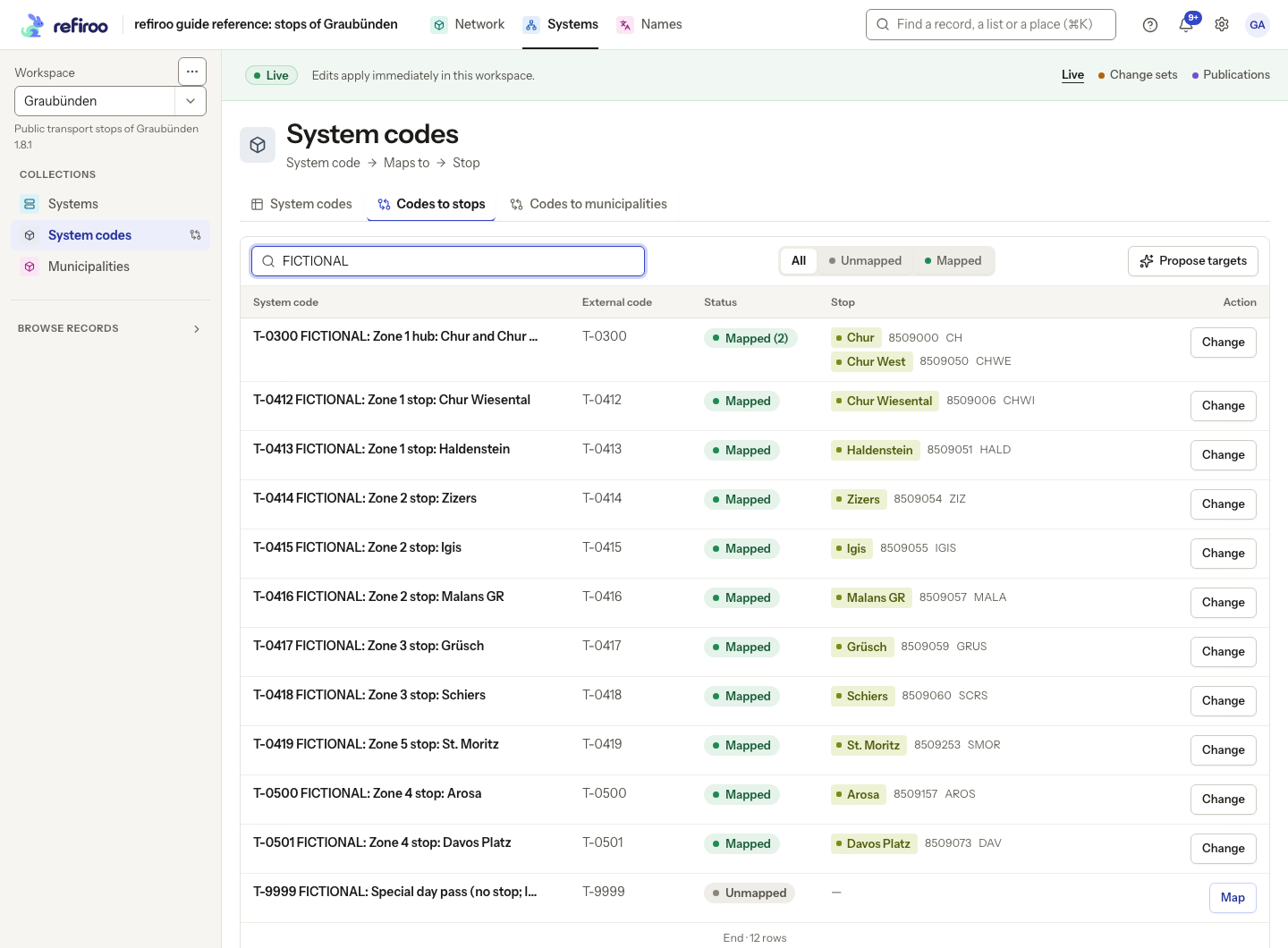
Above: Codes to stops is searched for FICTIONAL. Regional ticketing (FICTIONAL) and every T-code shown are invented. T-0300 connects to both Chur West and Chur to demonstrate ambiguity; T-9999 is deliberately unmapped. Other codes demonstrate a single mapping.
The fictional ticketing data uses real stop names and numbers so the connection can be inspected. It does not describe a real ticketing service or fare entitlement. Wikidata codes in the reference data are real item identifiers.
Names holds languages and name translations related to municipalities and operators. Its relation matrices compare those records across English, French, German, Italian and Romansh. It is the same idea as the starter model’s RDM Translations: records, an owning relationship and matrices, configured for different types. See Translations as an example.
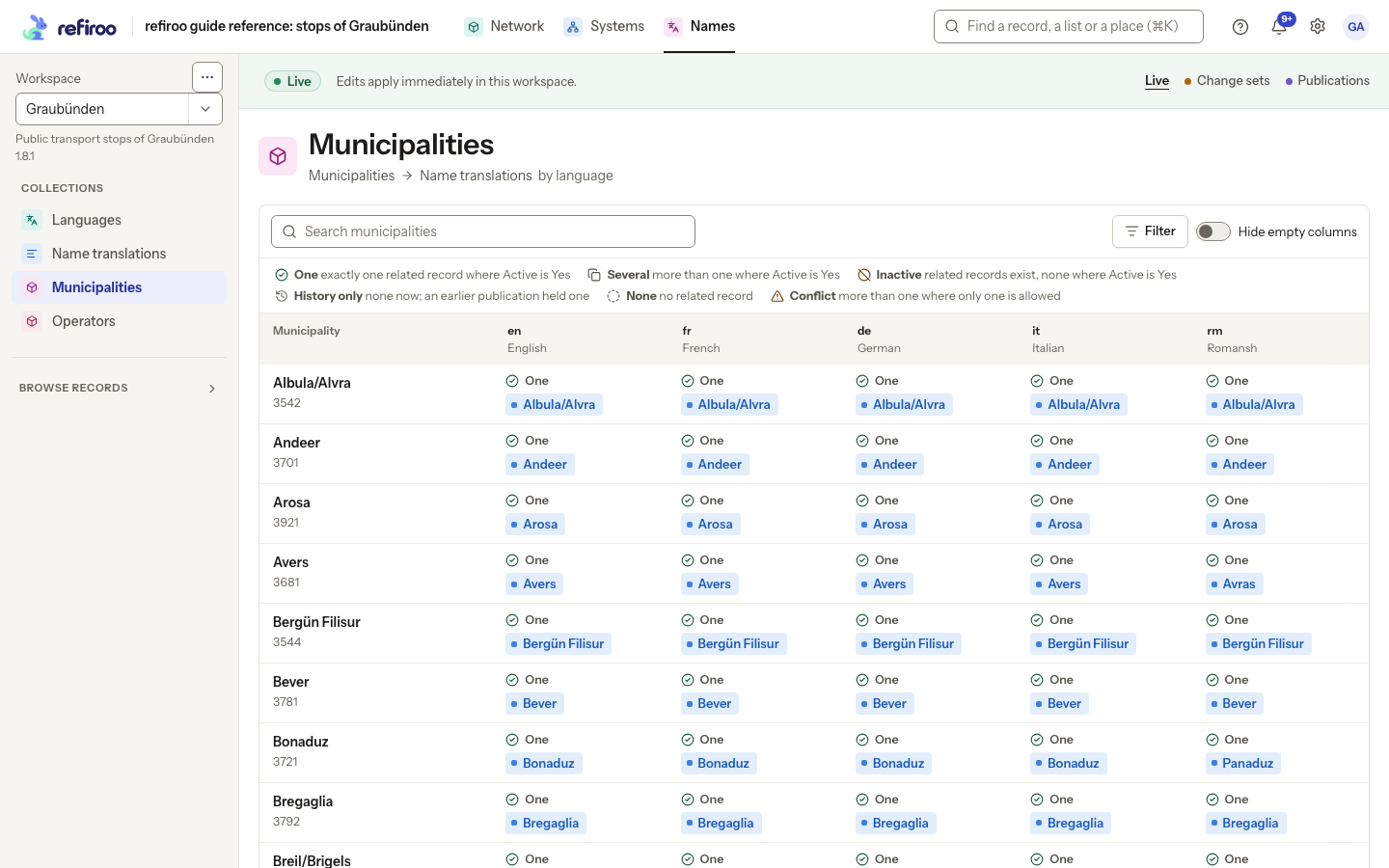
Above: Municipality names compares related name records by language. Active is Yes determines which records count in a cell under this model’s rule.
The guide also shows a missing Romansh name for Bonaduz. That name was removed for the captures, then the name Panaduz was recreated. Those screenshots demonstrate creation; they are not a claim that the name is still missing from the reference set. Other illustrated relationship and move dialogs were cancelled. For the working steps, see Fill in a relation matrix.
Working with the example
Section titled “Working with the example”These applications share the same change sets, publications and history as any other model. What you can read or change depends on your roles and grants. The model also declares a read-only contract for other systems; see The consumer API example.
Sources and attribution
Section titled “Sources and attribution”Stops, operators, means of transport, and the canton, district and municipality names and numbers come from the Didok service-point data, read through the SBB open-data service. Multilingual municipality and canton names and municipality and station item identifiers come from Wikidata. The reference set combines those sources with the clearly labelled fictional ticketing system.
Source: opentransportdata.swiss, Service Points (Didok), Federal Office of Transport / SBB, snapshot 2026-11-02. Wikidata, CC0.
These are sample records for learning the controls. Check current authoritative data before using names, codes or dates for operational decisions. The separate Default workspace in the screenshots shows the starter model without data.